
Scoping
How to write requirements for a client portal before the build stalls

· 5 min read
How do you write requirements for a client portal before building it?
Requirements are the rules of your app written in plain words: who logs in, who can invite whom, what each person can and can't do, and what every status means. Write them down and get the owner's yes before anyone builds another screen.
Earlier this year, a portal we were building for a payments company started to drag. Merchants apply for an account, upload documents, and the company reviews them before underwriting. Three kinds of people log in. The owner wanted more speed, and the obvious move was to push the developer harder.
I don't push harder. "By the time you're completely blocked, the train is stopped. But to get moving again at a good clip, it's gonna take forever. So look a little bit ahead on the track and get rid of whatever's in the way." What was in the way was that nobody had written down how the app was supposed to work.
Why write requirements down before you build?
Because the owner can only confirm what they can read. Until the rules are on a page, every screen is a guess, and nobody can tell which guesses are wrong.
Every app runs on hundreds of small decisions. Who gets in. What they see. When something counts as done. Owners carry those decisions in their heads and assume they're obvious. They aren't obvious to the developer, and the developer doesn't stop to ask about each one. He can't. He picks something reasonable and keeps building.
Writing requirements down moves those decisions back to the person who should make them. It also gives everyone one thing to point at. When a screen is wrong, the question stops being "what did you mean?" and becomes "does this match the page?" That's a five-minute fix instead of an argument.
What happens when you don't write them down?
The developer fills every gap with a default, and you discover each one in production, usually through a confused user, a support call, or bad data.
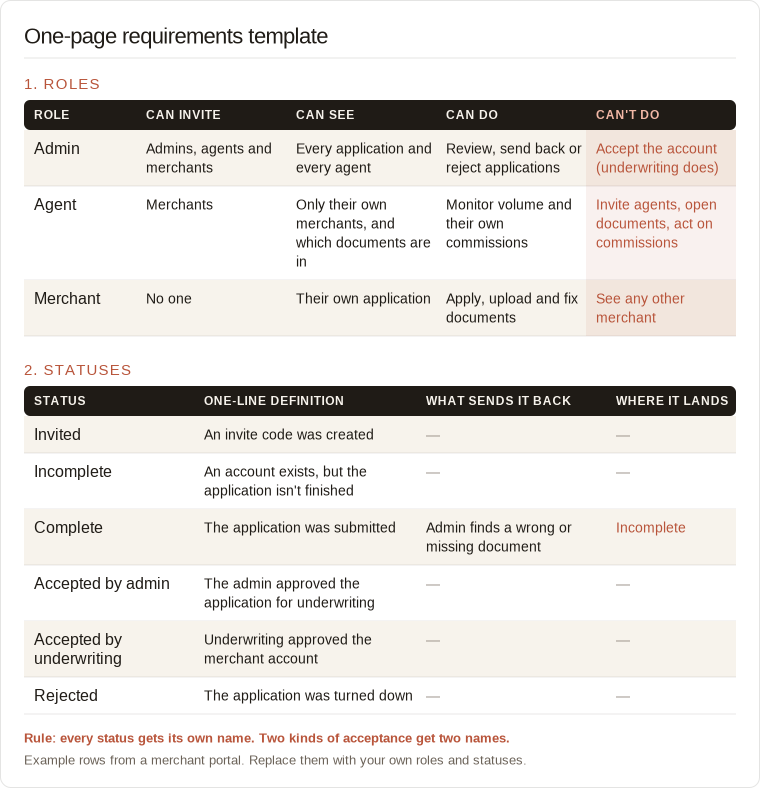
Take invitations. That portal was invite-only. Admins could invite admins, agents and merchants. Agents could invite merchants. When I asked whether agents could invite other agents, the answer was one word: "Negative." That word is a permission rule, a screen and a database check. Leave it unwritten and the build might allow it, and you find out when an agent starts recruiting other agents under them that nobody approved.
Take one word doing two jobs. The owner's team reviews every application before it goes to underwriting, so there are two approvals: the admin's and underwriting's. We'd been calling both "accepted." I stopped it as we wrote it: "Maybe I don't use the same word, because we have accepted down here." If that ships, a merchant sees "accepted," assumes they're approved, and calls their agent asking why they can't process payments. The developer gets a bug report for software that did exactly what it was told.
Take a record that moves backwards. An admin finds bank statements for the wrong company and sends the application back. If nobody decided what status it lands in, it can sit as "complete" while the merchant still owes documents, and the review queue fills with files that aren't ready.
None of these are coding mistakes. They're missing sentences.
By the time you're completely blocked, the train is stopped.
What does requirements extraction look like with a client?
I lead a working session, go role by role, push for the "no" answers, list facts before workflow, define every status, and end with the owner's sign-off.
Start with the roles, named by what each person is trying to get done. Merchants want to get approved. Agents want their merchants fully uploaded so they can start earning. Admins want clean applications reaching underwriting. Each goal tells you what that person needs to see.
Then ask the questions that produce a "no." Can agents invite agents? Can they open a merchant's documents, or only see that they were uploaded? On that portal, agents could see which documents were in but not open them, which was exactly enough to say "you still need to upload the rest." When I asked whether agents could act on their commissions, the answer was "No, they can't take actions. They can just monitor." The "can't" lines are where privacy and trust live, and they're the lines a developer is least likely to guess.
Keep it to facts first. I set that up front: "This is not sequential. This is just factual, right?" Start with the workflow and you describe the happy path, and everything off it disappears. List what's true first and the gaps show up on their own. The workflows come after, as paths through rules everyone already agreed on.
Define every status in one line, check that no two share a word, and for each one ask what sends a record back and where it lands. On that portal, a sent-back application returns to incomplete, because the merchant still owes something.
Then stop before the engineering diagrams. The first document has to be one the owner can read in five minutes and say "yes, that's how I want it to work." My standard for it is simple: if a buyer asked how this app works, I could hand them this page. After the sign-off, I walk the build against the page with the developer, the same way I recorded a client's process before automating it, and the page becomes the script the owner's team uses when they click through the app before anyone writes automated tests.
What this means for your business
If you're having a portal built, your developer is guessing at rules only you know. Before the next sprint, put one page in front of them:
- ·Every role, named by what that person is trying to get done.
- ·Who can invite whom, including the "no" answers.
- ·What each role can see, can do, and can't do.
- ·Every status in one line, with no shared words, and where a record goes when it's sent back.
Then ask the owner one question: is this how you want it to work? Build from the yes. That page is the start of what every app needs underneath it, one place your team works from, where people, automations and AI agents all read the same rules.